Date : Friday 19 June 2026
Time : 3am NZST | 1am AEST | 11pm AWST (Thurs 18th)
Presenter : Harry Heptinstall, PhD student, Centre for Advanced structural Ceramics, Imperial College London
Tungsten carbide-cobalt (WC-Co) hard metals underpin some of the most demanding industrial applications, yet the microstructural mechanisms governing their high-temperature deformation remain incompletely understood. Here, two WC-10 wt.% Co materials whose only processing difference is their dopants; 1.3 wt.% Cr, and 1.3 wt. % Cr(+Ti,V) – were deformed via four-point bending at 1100 °C, and EBSD maps acquired across the resulting strain gradient. Contiguity, Σ2 boundary fraction and {10–10} plane prevalence all indicate that deformation drives WC/WC boundaries toward lower-energy configurations – a grain boundary-mediated process strongly modulated by dopant content. Minor additions, such as Ti and V, measurably alter this response, demonstrating that compositional tailoring is a powerful lever for optimising hard metal performance. STEM and STEM-EDS analysis support these EBSD findings, providing evidence for the power of EBSD as a time and labor-efficient alternative to HREM techniques.
If you are unable to attend the live event, a recording will be sent to you via the registration information below.

Combining the best of AFM-IR and PeakForce Tapping
Read more
Manufacturers of Evactron Plasma Cleaning Systems
Read more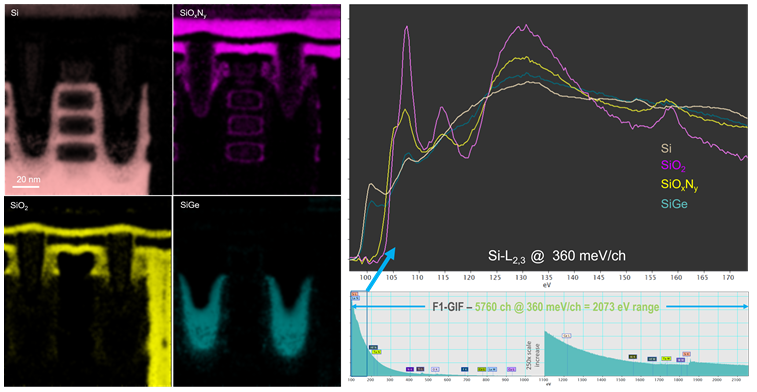
Dose-efficient wide-energy-range EELS with the F1-GIF system
Read more